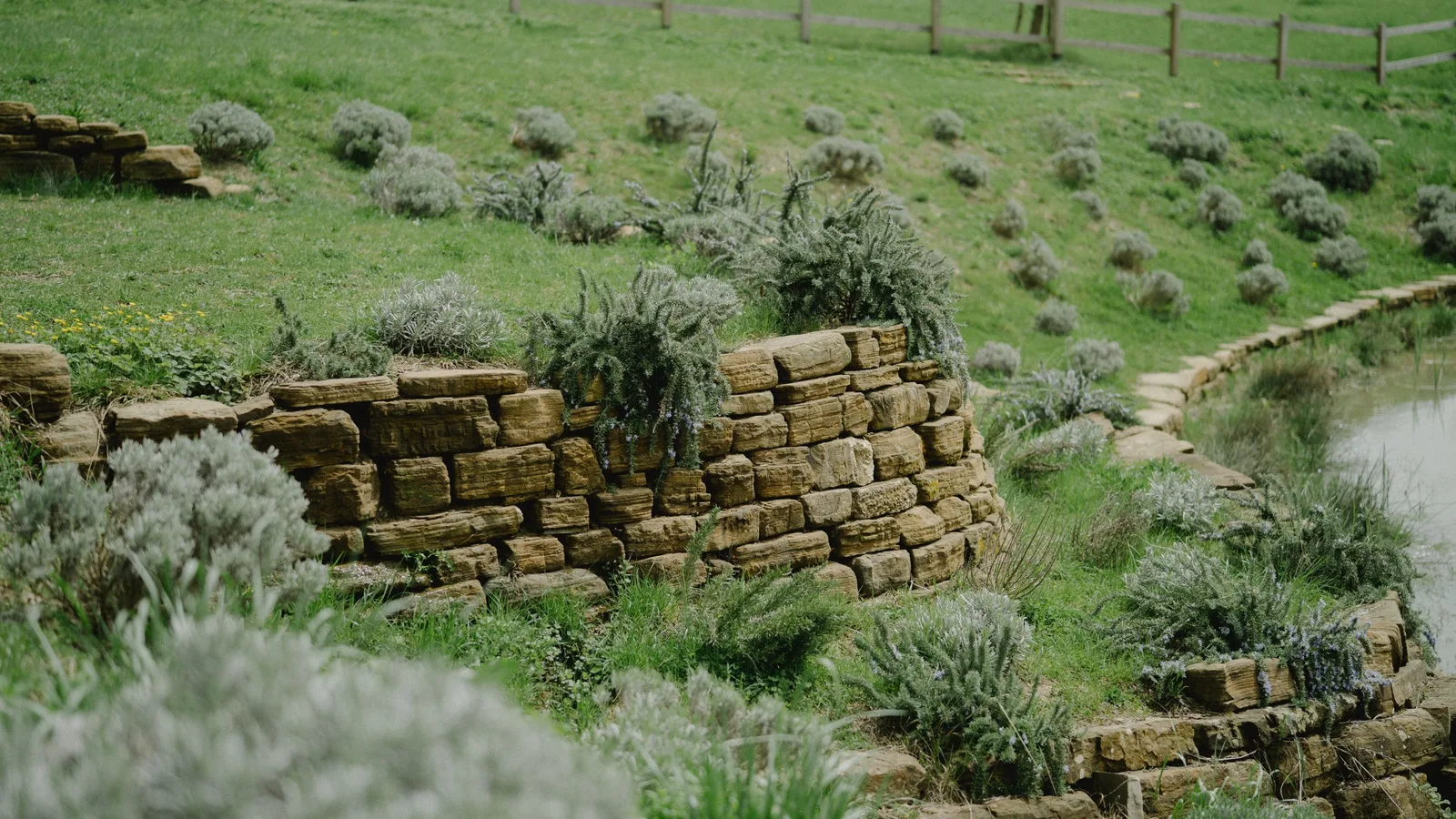
From the benches of Salt Lake and Davis counties to mountain lots in Summit County, a lot of Utah yards are built on a slope. A well-built retaining wall turns that slope into flat, usable space. A poorly built one leans, bulges or collapses. Here's what we look at.
Block or boulder? Segmental block walls give clean lines, consistent height and built-in caps, steps and planters — a good fit for modern homes and tight spaces. Stacked-boulder walls look natural, suit hillside and mountain properties and can be built tall with the right equipment.
The base is everything. Every wall needs a dug trench and a compacted gravel base. If the first course isn't level and solid, nothing above it will be.
Drainage stops the pressure. Water trapped behind a wall pushes on it — and in freeze-thaw winters, frozen soil pushes even harder. Drain rock and a perforated pipe behind the wall let water out before it builds pressure.
Lean into the hill. Block walls step back slightly with each course, and boulders are set leaning into the slope. That setback is what lets gravity hold the wall in place.
Know when to engineer. Taller walls, or walls holding up a driveway or structure, may need an engineered design and a city permit. We'll tell you when that applies.
FC Millennium Green builds block and boulder retaining walls across the Wasatch Front. Call (801) 574-8286 for a free estimate.